

TM 5-3810-300-24 & P3
CHAPTER I
General Information
PRINCIPLES OF OPERATION
The diesel engine is an internal combustion power unit, in
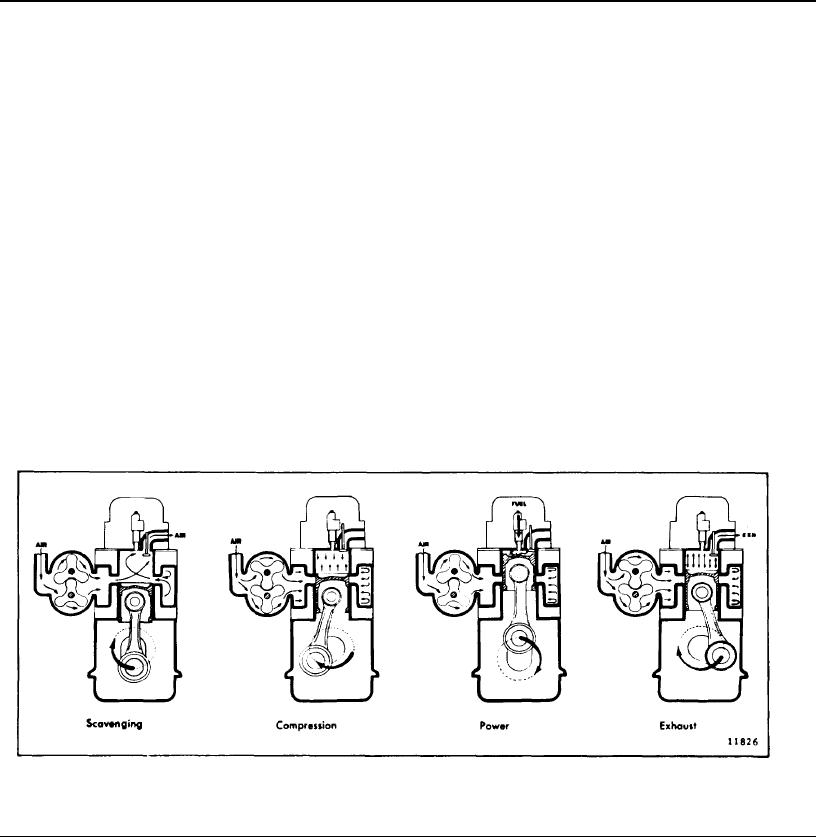
The unidirectional flow of air toward the exhaust valves
which the heat of fuel is converted into work in the cylinder of
produces a scavenging effect, leaving the cylinders full of
the engine.
clean air when the piston again covers the inlet ports.
In the diesel engine, air alone is compressed in the cylinder;
As the piston continues on the upward stroke, the exhaust
then, after the air has been compressed, a charge of fuel is
valves close and the charge of fresh air is subjected to
sprayed into the cylinder and ignition is accomplished by the
compression as shown in Fig. 1 (compression).
heat of compression.
Shortly before the piston reaches its highest position, the
The Two Cycle Principle
required amount of fuel is sprayed into the combustion
chamber by the unit fuel injector as shown in Fig. I (power).
In the two-cycle engine, intake and exhaust take place during
The intense heat generated during the high compression of
part of the compression and power strokes respectively as
the air ignites the fine fuel spray immediately. The combustion
shown in Fig. 1. In contrast, a four-cycle engine requires four
continues until the fuel injected has been burned.
piston strokes to complete an operating cycle; thus, during one
half of its operation, the four-cycle engine functions merely as
The resulting pressure forces the piston downward on its
an air pump.
power stroke. The exhaust valves are again opened when the
piston is about half way down, allowing the burned gases to
A blower is provided to force air into the cylinders for expelling
escape into the exhaust manifold as shown in Fig. I (exhaust).
the exhaust gases and to supply the cylinders with fresh air for
Shortly thereafter, the downward moving piston uncovers the
combustion. The cylinder wall contains a row of ports which
inlet ports and the cylinder is again swept with clean
are above the piston when it is at the bottom of its stroke.
scavenging air. This entire combustion cycle is completed in
These ports admit the air from the blower into the cylinder as
each cylinder for each revolution of the crankshaft, or, in other
soon as the rim of the piston uncovers the ports as shown in
words, in two strokes; hence, it is a "two-stroke cycle".
Fig. I (scavenging).
Fig. 1 - The Two-Stroke Cycle
Page 5